
Malay apple: a flower born from old wood
Its flowers emerge from mature branches; its fruits tell a story of travel, human selection, and chemistry concentrated in the skin.
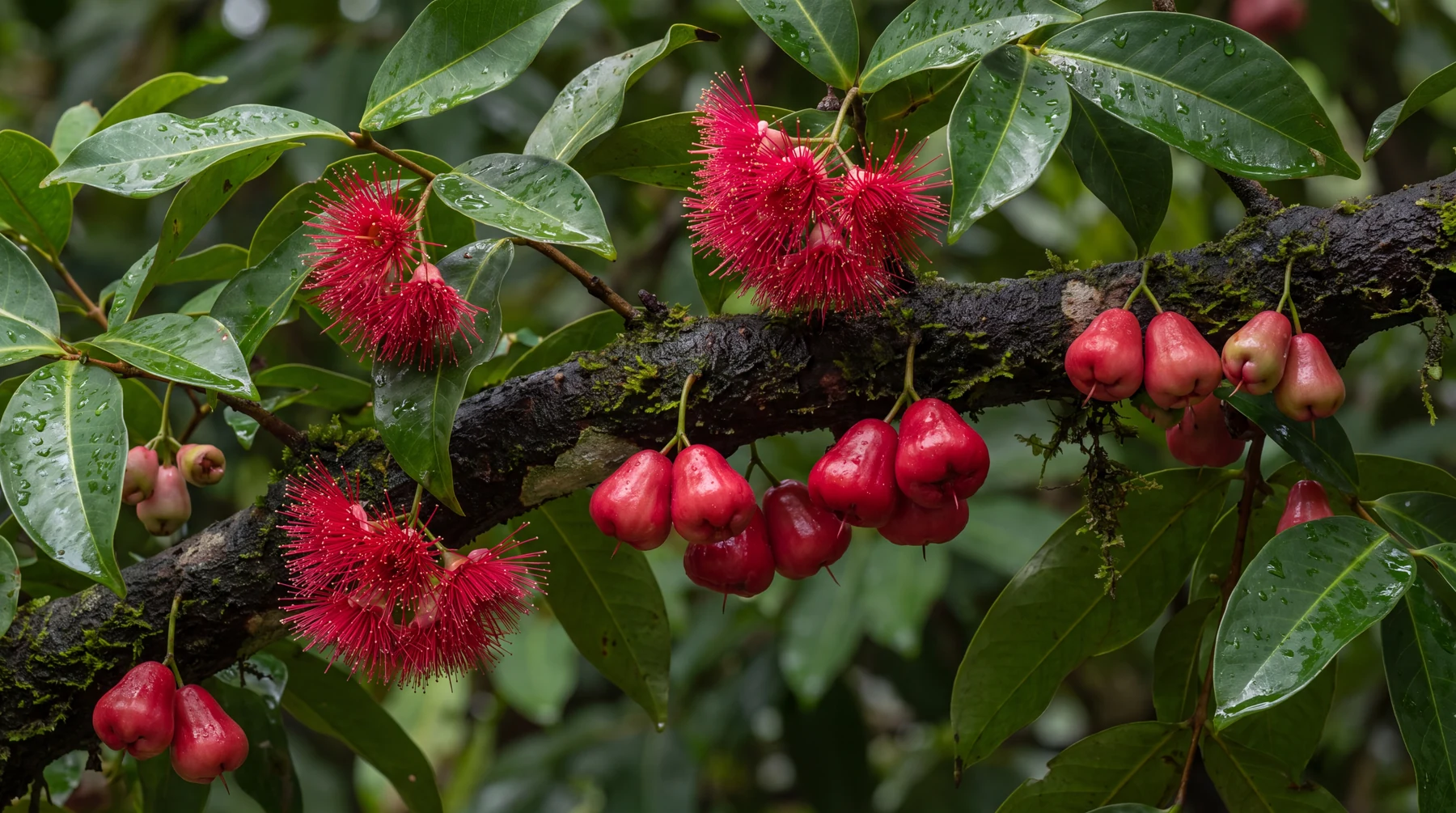
A calendar hidden in a branch
On many trees we search for flowers at the tip of a new shoot. Malay apple shifts that expectation: its inflorescences can arise from the upper trunk or bare portions of older branches. Cauliflory refers to flowering on the trunk; ramiflory describes flowering on mature branches. The distinction helps us locate precisely where a future fruit begins.
Wood that seems to have finished growing retains points capable of bearing new flowers. Each inflorescence carries several blooms; their colour comes chiefly from long stamens rather than large petals. When they fall, those filaments may tint the ground beneath the crown. The tree thus offers two scenes at once: leaves gathering light above, old wood entering a reproductive phase within.
A fruit carried by people
Kew places the native range between Indochina and Vanuatu and records introductions through much of tropical America, including Costa Rica. This species did not originate spontaneously in this landscape. Its presence reminds us that farms and gardens archive human preferences too: trees are carried for shade, beauty, flavour and the possibility of sharing a harvest.
ACIAR describes variation among trees in fruit colour, size and taste, along with local propagation of favoured individuals. Such everyday selection is a form of domestication without a laboratory: a household preserves a desirable tree, and a region accumulates generations of small decisions. Variation in fruit is not a flaw in identity; it belongs to the history of cultivation.
What flesh and skin contain
Pale, watery flesh explains the refreshing quality behind its common names. The fruit is often eaten fresh; that same delicacy limits storage and transport. A fruit that spoils quickly may be highly valued close to the tree yet scarcely appear in distant markets. Proximity is part of this crop’s flavour and economy.
A PLOS ONE study examined the edible portion and peel of Malay apples separately. It identified cyanidin 3-glucoside as the principal anthocyanin associated with the red colour and measured phenolic compounds and antioxidant activity in extracts. These are findings about the composition of samples, not promises of medical treatment. They reveal something more useful to an observer: red skin and pale flesh are tissues with distinct chemical histories.
Looking beyond the fruit
When the crown is green and no fruit is present, the tree remains active. Broad leaves sustain photosynthesis; mature branches retain sites of future flowering; shade changes the space available to people, animals and other plants. On the Chachagua specimen, smaller plants even occupy the trunk. A tree is not a fruit dispenser hanging in air: it is an inhabitable structure.
Dendrological observation connects these scales without confusing them. A fruit photograph shows a feature of Syzygium malaccense; the individual image tells us about this particular tree and its place. When a Malay apple next appears at a market, we might reconstruct the path in reverse: from glossy peel to fine-stamened flower, and from there to the old branch that bore it.
Sources and further reading
Original synthesis based on the following publications.