Mahogany before it becomes timber
Winged seeds, light and a small shoot borer: the story of Swietenia macrophylla begins long before a harvestable trunk.
A journey beginning in a capsule
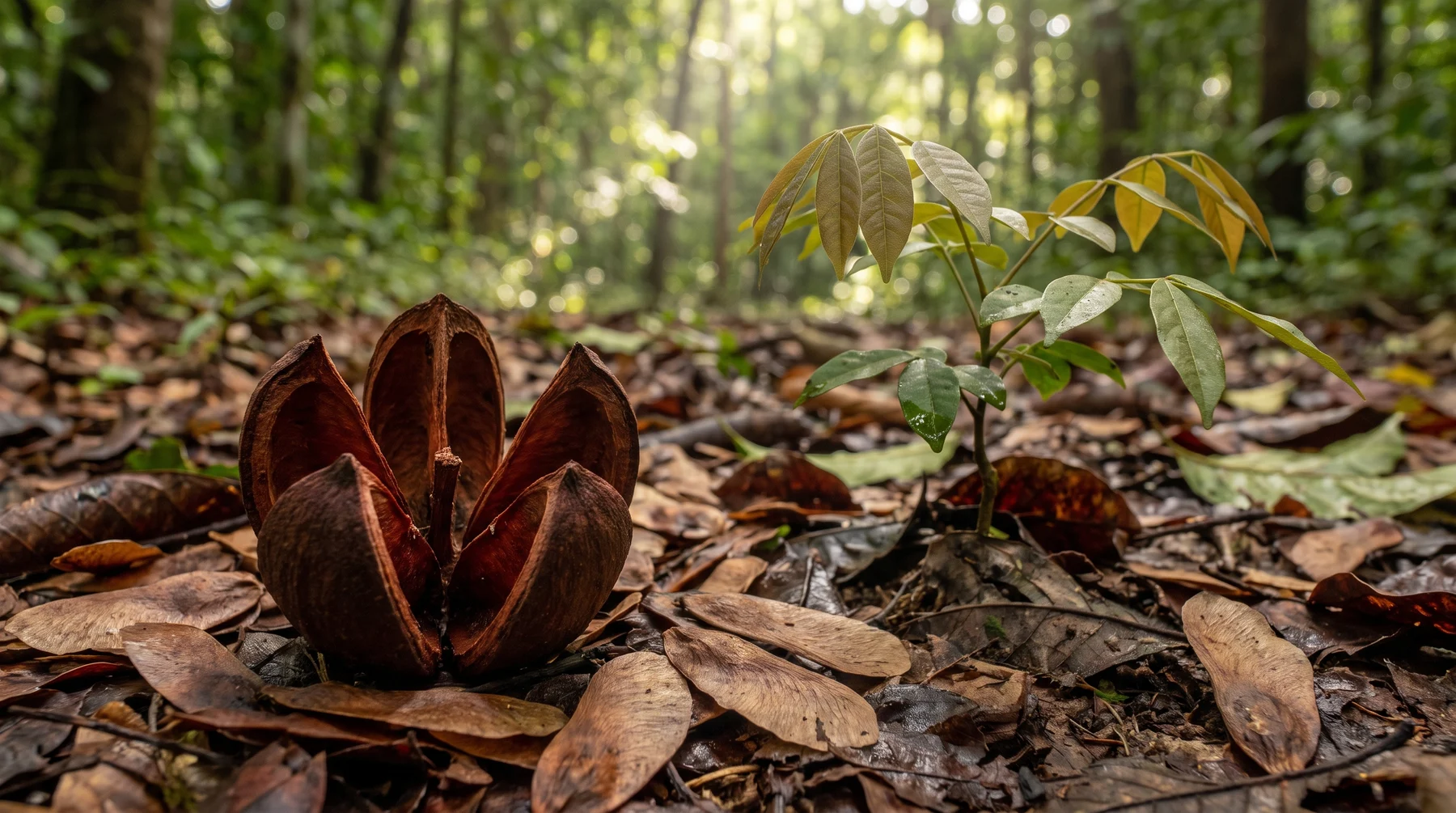
Before imagining a mahogany board, look at the fruit. Swietenia macrophylla forms woody capsules that open to release winged seeds. The structure provides a departure route: offspring can leave the crown with help from the wind. Reaching the ground, however, is not the same as becoming a tree.
Light influences the species’ growth. A seed may reach a place that allows germination but cannot sustain later development. Dispersal and establishment are therefore different problems. One question concerns where a seed arrives; the next concerns what it finds there.
An insect shaping a trunk
Mahogany silviculture repeatedly encounters Hypsipyla grandella, the shoot borer. Damage to apical growth can change the tree’s form. The relationship seems disproportionate: a small insect influences the trajectory of a potentially enormous trunk.
A study of clonal plantations in northeastern Costa Rica, published by Chinchilla, Corea and Meza in 2020, examined early growth and management costs. It included borer control and differences between clones. The findings describe particular trials, not a promise of identical performance for plantations throughout the country.
Seeds carry different histories
Navarro and Hernández compared Mesoamerican progenies and provenances in northern Costa Rican trials. Growth differed between families and populations, and offspring from some isolated trees grew less. The authors discussed a possible role for inbreeding. A seed’s origin therefore carries information that its appearance cannot reveal.
A seed family shares a parental origin; provenance describes geographic origin. A clone replicates a genotype through vegetative propagation. These are different tools. Confusing them makes discussions of restoration, timber production and genetic conservation less precise.
Planting trees and rebuilding a forest
Selecting material for rapid growth may serve a production goal. Rebuilding ecological relationships or conserving genetic variation requires additional questions. Where did the material come from? How many origins are represented? What conditions will the site provide in future years? A species label cannot answer all of them.
In Costa Rica, where mahogany belongs to the native flora, these distinctions support a more precise discussion of its future. Timber is one possible outcome of a life, not its complete description. Looking at a capsule, a shoot or a compound leaf restores the processes that disappear when the final product dominates the story.
Sources and further reading
Original synthesis based on the following publications.