Spanish cedar: a tree’s future begins in a bud
A tiny moth can change the architecture of a young cedar; an open capsule gives the wind dozens of possibilities.
The bud that organises the trunk
In a young cedar, the terminal bud guides the extension of the main axis. As it grows, this point only millimetres wide organises an architecture that may eventually reach tens of metres. Lateral branches are not a fixed drawing: they respond to light, damage and competition among shoots to continue growth.
The open crown of a juvenile lets us observe several axes and where they join. Without a continuous record of development, a particular fork cannot be assigned a specific cause. The broader principle matters: when a dominant bud is lost, other shoots may take its place. The shape of a tree preserves in wood some of what happened during its youth.
A moth against the straight line
The larva of Hypsipyla grandella, the mahogany shoot borer, can enter a fresh shoot and damage tissue behind its tip. If the terminal bud dies, several lateral shoots compete to replace it; the bole may develop multiple leaders. For timber production this reduces the length of a straight trunk, but for the tree it is a survival response, not a moral defect.
A provenance trial in Yucatán compared growth, attacks and branching in young cedars. It found growth differences among seed origins but no simple genetic solution to borer susceptibility in those tests. The practical lesson is that a tree is not managed by choosing just one supposedly “good” seed. Provenance, site and care matter, and observed responses need testing in more than one environment.
Why the surrounding landscape matters
The US Forest Service describes less frequent attacks in natural forests, where host trees are scattered, than in dense cedar plantations. Concentration changes the encounter between insect and plant. A uniform stand may make tender shoots easier to find; a diverse landscape brings distances, shade and different rhythms.
This does not mean diversity guarantees immunity or that every plantation behaves alike. It means planting design belongs to the biology of the result. Thinking about mixed species, seed origins and light conditions is more useful than watching growth speed alone. A cedar meant to live for decades starts its story in decisions made while it is still small enough to fit beneath a hand.
The capsule that releases a future forest
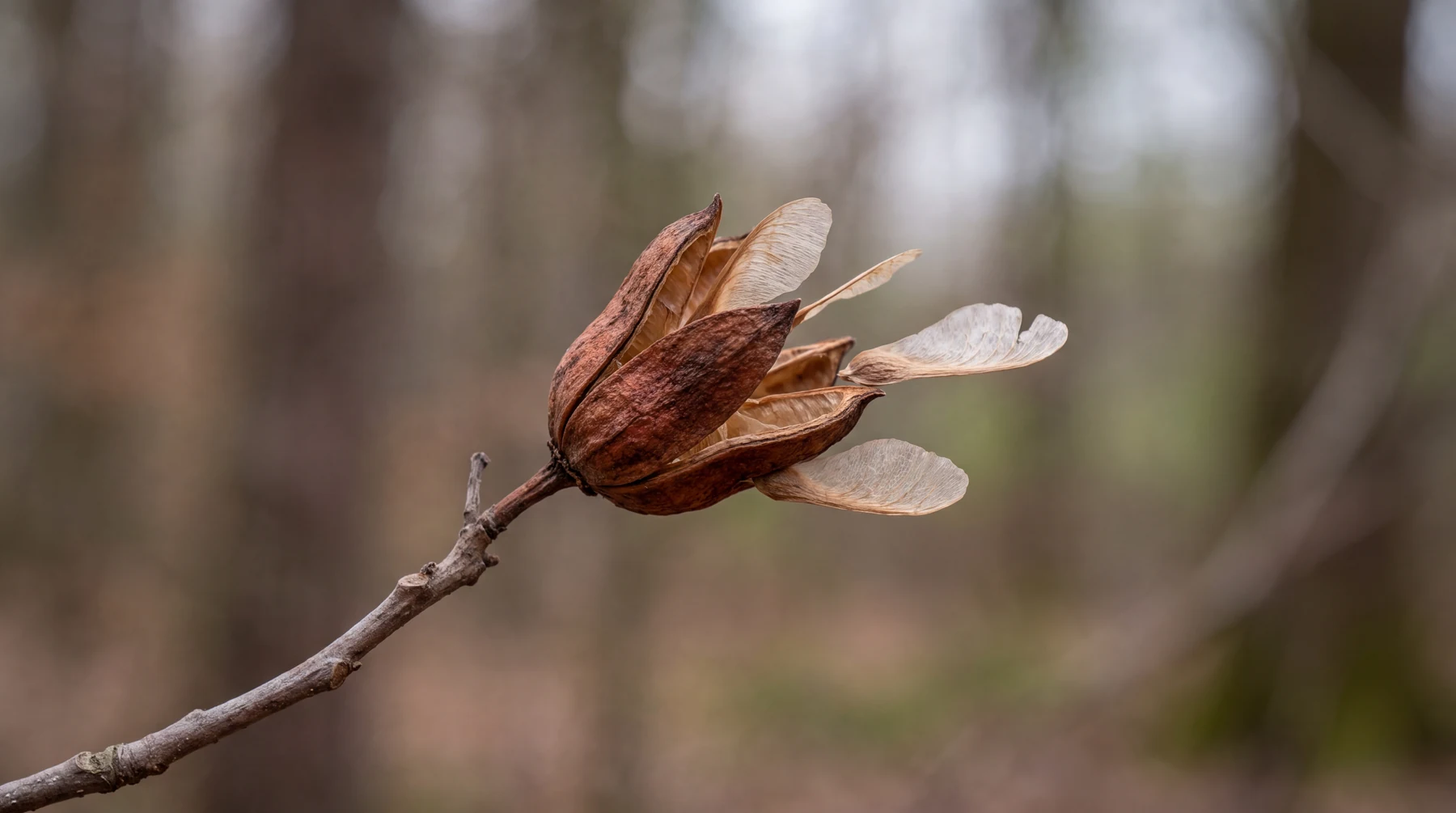
As it matures, Spanish cedar produces woody capsules that open while still attached to the branch. Each can release dozens of flat winged seeds. Wind moves them in the drier season; with the first rains, those that reach suitable ground may germinate. The open capsule is more than a distinctive shape: it is a dispersal device synchronising maturity, air and opportunity.
Kew records Cedrela odorata as globally Vulnerable. Conserving it does not mean straightening every trunk or producing more timber at any cost. It also means keeping reproductive trees, genetic diversity and places where a seed can become a juvenile. In Chachagua we see an early chapter. Its interest does not depend on fruiting yet; it lies in everything it may still build.
Sources and further reading
Original synthesis based on the following publications.