
The monkey pot: a lidded fruit and a feast for bats
It takes almost a year to ripen, opens like an uncovered pot and offers its seeds to the animals of the night. This is how a threatened giant of northern Caribbean Costa Rica reproduces.
A pot that takes a year
The fruit of the monkey pot is a woody capsule that hangs from the branches like a vessel. It is 15 to 30 cm long and its wall can be up to 3 cm thick. On the outside it is smooth and reddish brown.
Making it takes time: about ten months pass from flower to ripe fruit. In Costa Rica, the fruits that come from the mid-year flowering ripen and open between March and May of the following year.
The falling lid
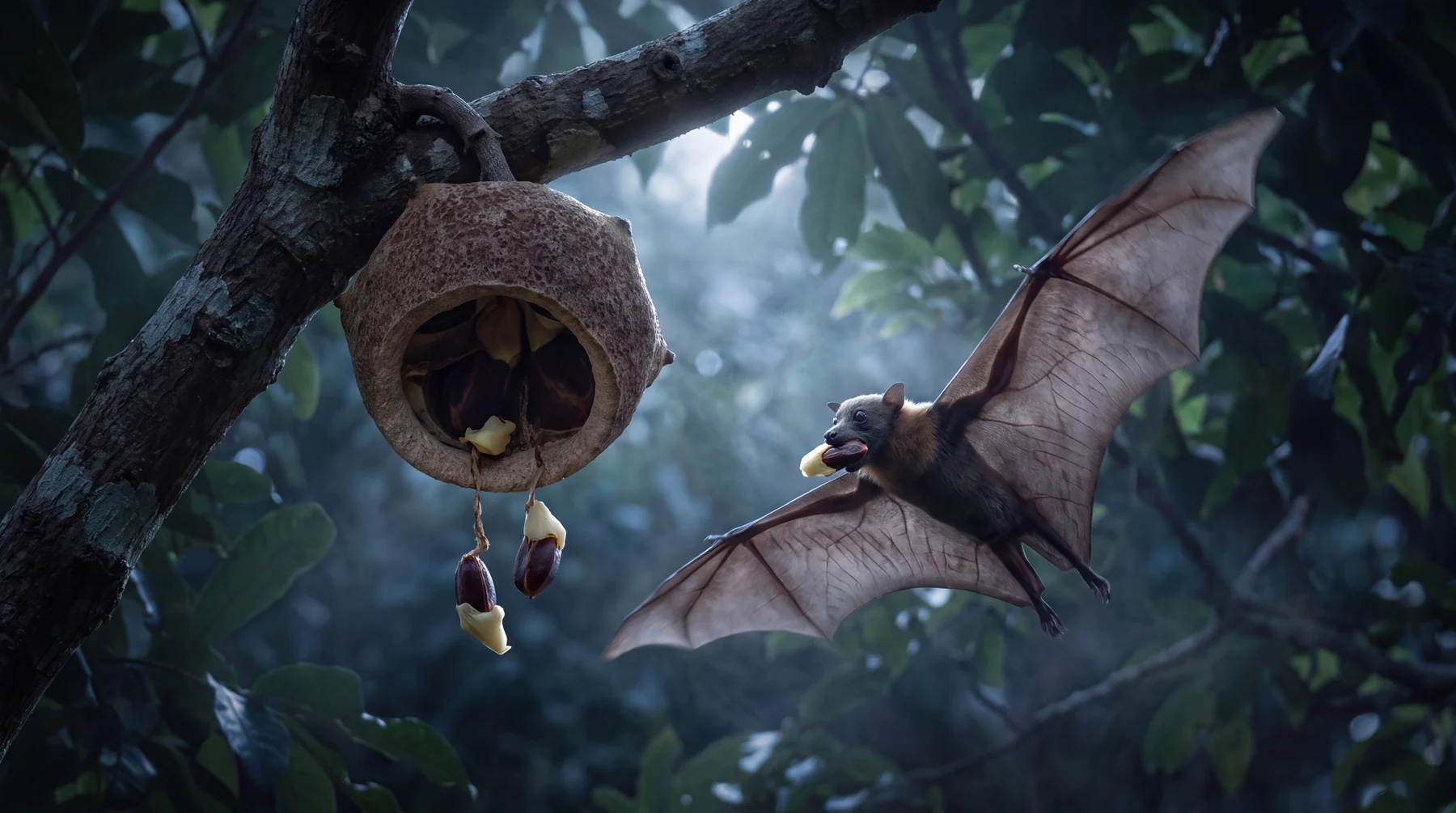
Botanists call this kind of fruit a pyxidium: a capsule that opens by a lid. In the monkey pot that lid, the operculum, falls away when the fruit ripens and leaves the mouth of the pot facing down.
Inside there are on average about 36 seeds, although roughly a quarter never develop. The well-formed ones are elongated, 5 to 9 cm long, and in the genus Lecythis they stay attached to the fruit wall by a cord, the funicle, wrapped in a white, fleshy aril. That aril is the bait.
A night-time feast
In the monkey pot, bats eat the aril, and parrots and parakeets seek it out too. In a close relative, Lecythis pisonis, bats such as Phyllostomus hastatus have been seen removing the seeds with their aril on the same night the fruits open. They eat the fleshy part and drop the intact seed in flight or under their roosts, far from the parent tree.
Other animals wait on the ground. Pacas, agoutis and deer eat the seeds, and some rodents may disperse the ones they bury and forget. The seed cannot survive drying out: it germinates soon or it is lost.
The monkey, the pot and selenium
The name monkey pot is used for several species of Lecythis. It is often explained with an old saying: a wise monkey does not put its hand in the pot. Young ones reach in for the seeds, close a full fist and cannot pull it back out.
The seeds of several species in the genus are edible, and in northern Costa Rica those of the monkey pot have been used to make sweets. Moderation matters: in a relative, Lecythis ollaria, the seeds accumulate so much selenium that eating too many has caused poisoning with hair loss.
Today the greatest risk to the species is not animals but logging. Its hard, heavy wood was much sought after, and the monkey pot is listed among Costa Rica's threatened trees. An adult like the one in Sarapiquí, with fruits in its crown, is a source of seeds for the forest to come.
Sources and further reading
Original synthesis based on the following publications.
- New York Botanical Garden · Lecythidaceae Pages · Lecythis ampla
- Tropical Tree Seed Manual (USDA) · Lecythis ampla
- ScienceDirect Topics · Lecythis
- Wikipedia · Lecythis ampla
- Wikipedia · Lecythis
- Müller y Desel (2010) · Acute selenium poisoning by paradise nuts (Lecythis ollaria)
- Especies forestales vedadas y bajo otras categorías de protección en Costa Rica