A eucalyptus stand is not a forest
Eucalyptus grandis invites a careful reading of plantations: origins, management and water matter as much as tree height.
Start with the bark
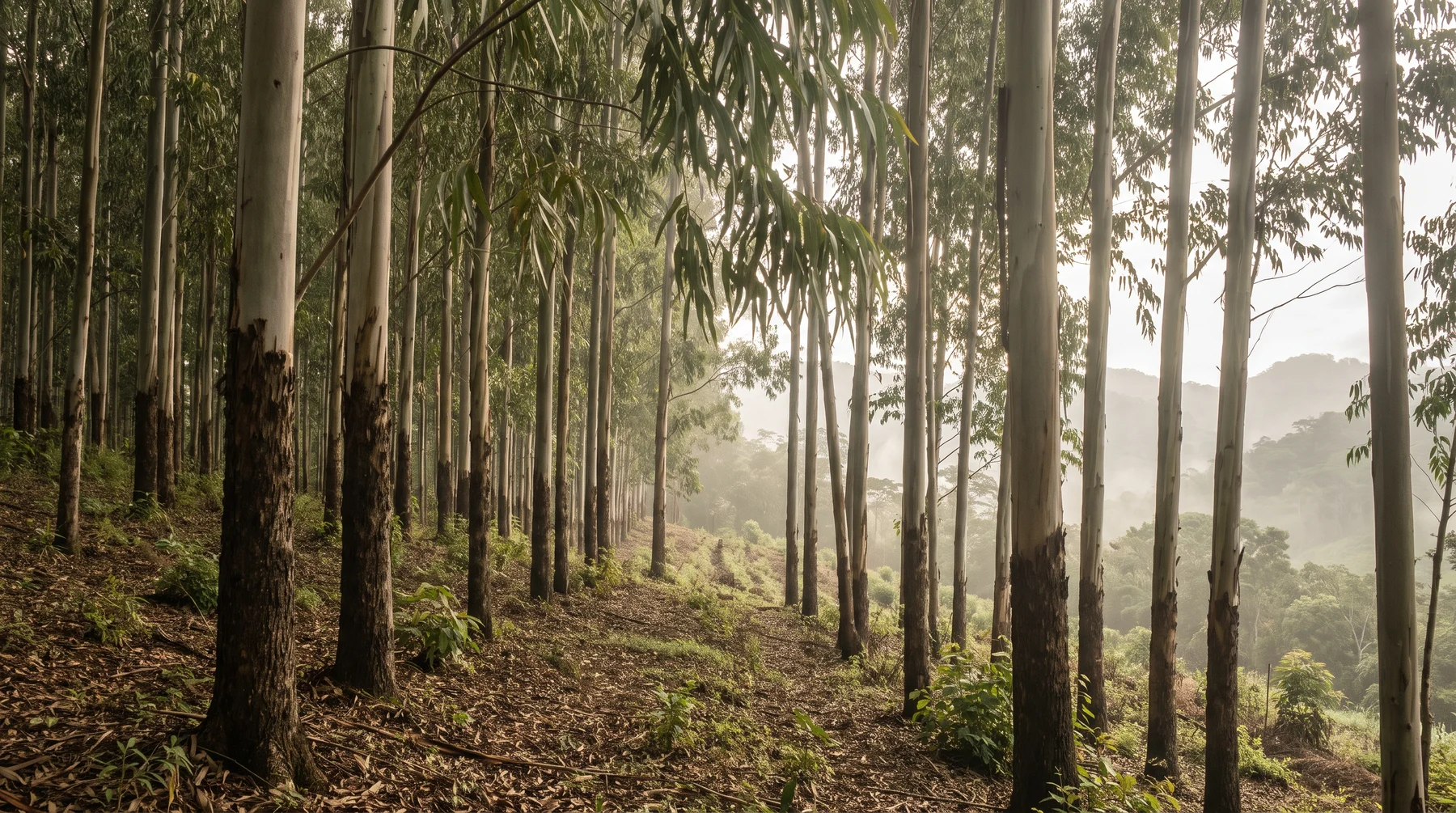
A pale eucalyptus trunk draws the eye upward, but its base also tells a story. The botanical description of Eucalyptus grandis distinguishes rough lower bark from smoother surfaces above. Elongated adult leaves complete an architecture that should not be confused with the multicoloured bark of other eucalyptus species.
The flora of New South Wales places its origin in eastern Australia. Finding it in Costa Rica therefore raises questions about management: how did it arrive, why was it planted and what function does it serve? Identifying a species can also mean reconstructing a human decision.
Turrialba: growth belongs to a site
Alberto Sánchez’s 1994 CATIE research studied Eucalyptus grandis and E. deglupta in three farm planting systems in Turrialba. It related growth to soil and stand variables and discussed thinning needs. The study illustrates why a growth figure loses meaning when separated from the conditions that produced it.
Thinning removes some trees to change the space available to those remaining. It is neither synonymous with restoration nor a universal recipe. The same intervention means different things when the goal is timber, soil protection, habitat diversity or an explicit combination of objectives.
Water requires a comparison
Saying that a tree uses water is true but insufficient for evaluating a plantation. The useful question concerns changes relative to previous land use, in that climate and at that scale. Rainfall, evaporation, transpiration and storage cannot be reduced to one universal property of a genus.
FAO syntheses of eucalyptus and forest–water relationships emphasise site and management context. Under water scarcity, demand from fast-growing plantations deserves particular attention. This does not establish that every eucalyptus dries every river. Equally, it does not justify ignoring local effects that require measurement.
One useful function does not replace all others
Tall trunks can resemble a forest from a distance. Closer inspection reveals differences in composition, age, understory and land-use history. A managed plantation does not automatically reproduce native forest relationships. Recognising a production benefit and recognising that distinction are compatible positions.
A careful reading of a Costa Rican landscape asks what came before and what is intended next. Did the planting replace pasture or native vegetation? How are areas around watercourses protected? What monitoring will guide adjustments? The gallery tree invites species recognition; understanding its presence means looking beyond the frame.
Sources and further reading
Original synthesis based on the following publications.