
Five golden days: the yellow cortez and the dry-forest clock
It spends months without leaves, waiting for a signal. When the signal comes, it blooms within days, and each flower lasts only one.
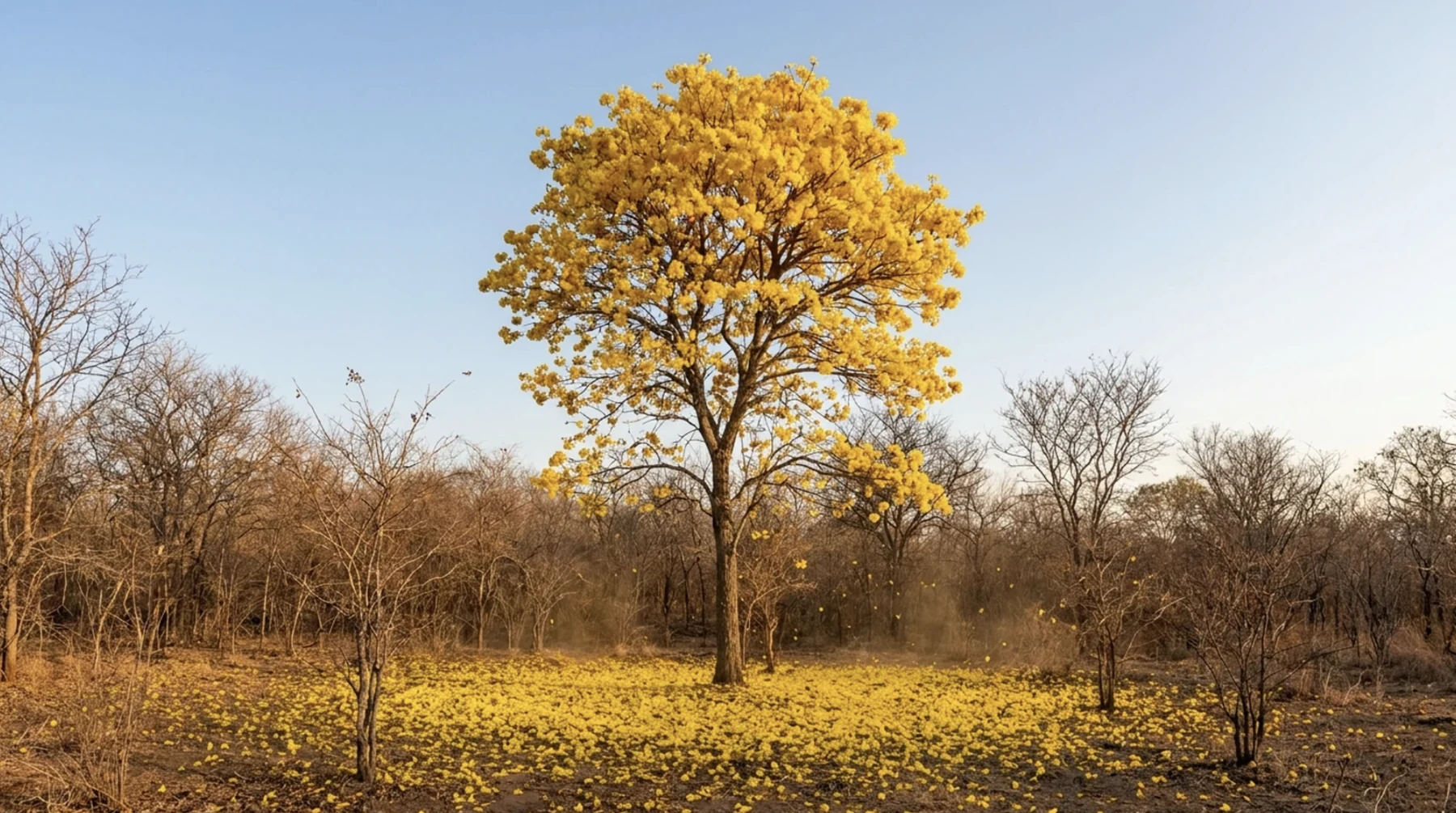
Waiting without leaves
Between December and February, when the dry wind sweeps across Guanacaste, the yellow cortez loses its leaves. It sheds every one, and in the dry forest its crown can stay bare for up to five months. From a distance it blends in with the other grey trees on the hillside. It looks like a tree on pause, but it is getting ready: the flower buds are already formed at the branch tips, waiting only for the signal to open.
That signal is not a date. The Guanacaste Conservation Area's natural-history notes describe how, in the middle of the dry season, an out-of-season rain or the arrival of a cold front is enough for the tree to flower six to seven days later. Rain is not always needed: a drop in temperature can also trigger flowering. Because every cortez in an area receives the same signal at the same time, a landscape that has been grey for weeks turns yellow almost overnight. What looks like a sudden spectacle is really the coordinated response of many individuals to the same cue from the weather.
That coordination makes sense. Without leaves, the flowers are fully exposed and visible from far away, both to people and to the animals that seek them out. At a time of year when the forest offers very little food, a crown in bloom works like an advertisement impossible to ignore.
One flower, one day
Speed is part of the strategy. Each cortez flower lasts a single day, and the whole crown stays at its peak for only four or five days. In that short window come bees, wasps, flies, butterflies and hummingbirds. The main pollinators are large bees, able to enter the trumpet-shaped flower and leave covered in pollen. Not every visitor does that job: some hummingbirds and carpenter bees pierce the flower or take the nectar without touching the pollen, taking the food without pollinating.
Another detail explains why they all bloom at once. Flowers on the same tree do not fertilise one another, so the cortez needs pollen to arrive from other individuals. A tree flowering alone, out of sync, would have almost no one to exchange pollen with. Mass flowering is, in that sense, a collective agreement: the more trees open at once, the more likely bees are to travel from one to the next.
When the window closes, the flowers fall. The yellow circle beneath the tree in this gallery is the trace of those days: a carpet that marks the reach of the crown and soon turns brown. About three weeks later the long, slender pods ripen. Inside, white winged seeds wait for the end of the dry season to be released on the wind, just before the rains begin. Viable seeds germinate during the first month of the wet season, when the soil finally holds water.
That synchrony also has a cost. So many seeds concentrated in so few weeks attract the animals that feed on them: white-faced capuchin monkeys eat seeds that are still developing, and the larvae of a moth can destroy most of the seeds inside a pod. Part of the crop is lost before it ever reaches the ground.
When the landscape changes the clock
For a long time the cortez was thought to follow a fixed pattern. Between 2014 and 2017, biologist Jorge Lobo-Segura of the University of Costa Rica followed 164 trees in seven populations across the country, six of them in Guanacaste's dry forest. He found two very different behaviours.
In protected forests, flowering was explosive: every branch opened at once, and the timing was set by the start of the rains, between late April and early June, after several months of bare crowns. At two more disturbed and fragmented sites another pattern appeared. There, flowering was staggered: it began in December, moved branch by branch until April, peaked one or two months before the rains and let new leaves sprout almost immediately. The study also found that proximity to rivers or streams did not explain the difference, contradicting earlier models based on soil moisture.
This has an important consequence: the same species, in different landscapes, can keep different clocks. If a tree flowers out of step with its neighbours, its chances of receiving pollen change, as do the moment its seeds reach the ground and the animals that depend on those flowers. Looking at a cortez in bloom, then, is not just looking at a beautiful tree. It is reading the state of the forest around it.
That is why it matters to record each flowering with its date, place and the condition of its surroundings. A single yellow tree is a moment; many records over the years make it possible to understand how the dry forest responds to changes in climate and land use. The image in this gallery is a visual reference with sample data: a first step toward that kind of archive.
Sources and further reading
Original synthesis based on the following publications.