A forest within a tree
On a branch or halfway up a trunk, another landscape can begin: the world of epiphytes.
A plant halfway up
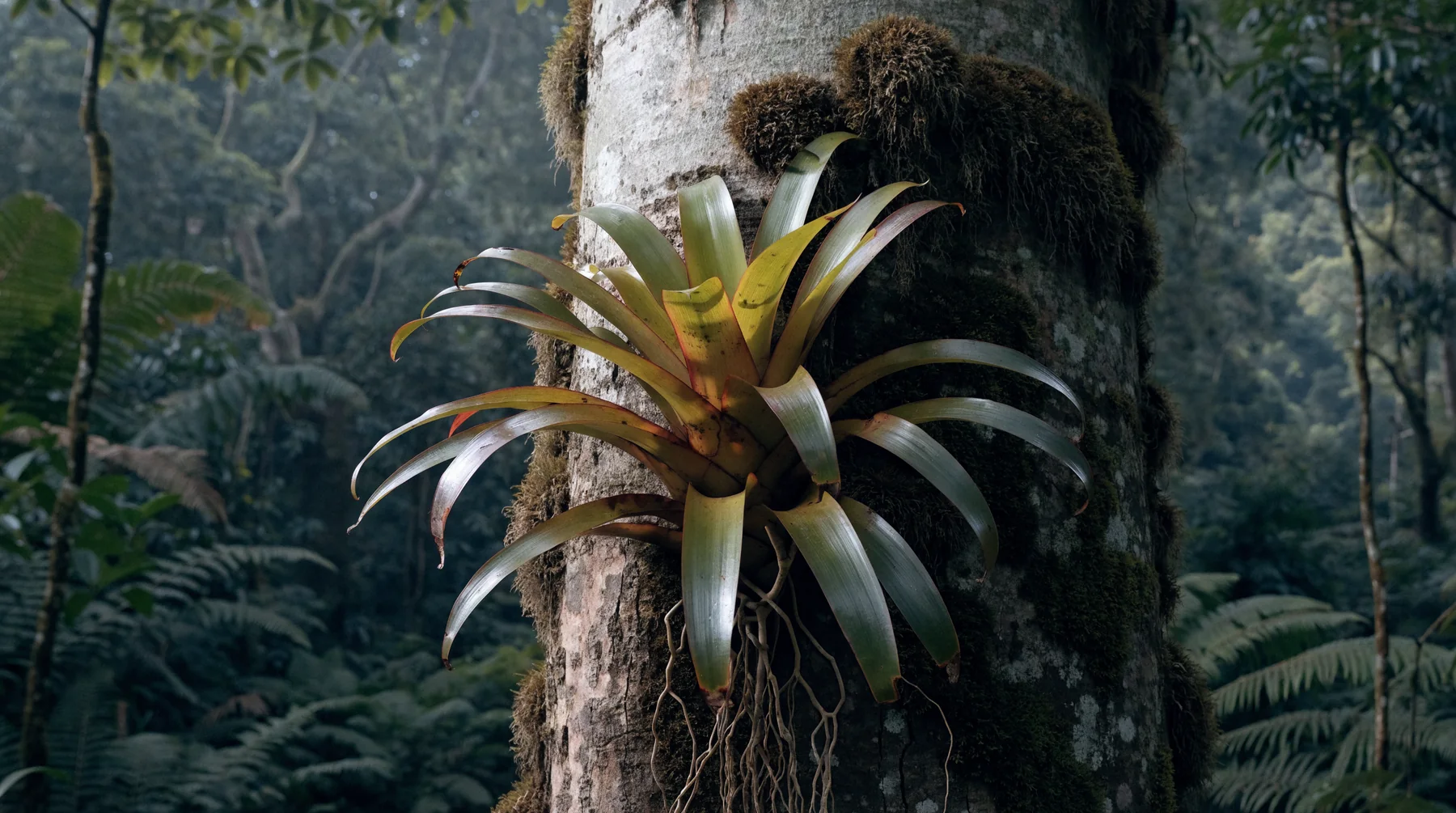
In a photograph of the gallery’s monkey pot tree, a small bromeliad sits halfway up the trunk. From a distance it might look like a green ornament attached to the bark. Up close, the scale of the scene changes: its leaves gather water, dust and fragments of other plants; its roots hold to the trunk’s irregular surface. The tree is no longer one isolated organism against a white background. It is also a place where another living thing found a way to settle.
Plants that live on other plants without taking food directly from them are called epiphytes. The distinction matters: a bromeliad growing on a tree is not the same as a parasite. It uses the tree as support to reach an environment unlike the ground, with different light, wind and access to water. The host tree still matters: its age, bark and branching pattern offer different surfaces. The epiphyte reminds us that the architecture of a tree creates living space.
Water held above ground
Some bromeliads arrange their leaves in rosettes that retain rainwater. These reservoirs, known as phytotelmata, can collect organic matter and become habitats for microorganisms and invertebrates. Life then gathers in a few centimetres of water suspended above the forest floor. Not every bromeliad makes such a reservoir, and a photograph alone cannot establish the identity or behaviour of this individual. Closer observation would be needed.
Yet the possibility changes how we look at the canopy. Forests have long been studied mostly from below, where people walk and most samples are taken. Above us lie surfaces, moisture and small habitats that a general view of the crown cannot reveal. An epiphyte can be part of that mosaic, alongside mosses, lichens, fungi and visitors that arrive or take shelter for a while.
Height changes the rules
Living on a tree means solving problems that the soil solves differently. There is no deep, continuous water reserve into which to extend roots. Rain arrives all at once and may vanish quickly; wind dries leaves, while crevices in the bark hold tiny amounts of organic material. Many epiphytes therefore have structures that capture moisture or endure dry spells. Their form is not an ornament: it is an answer to where they live.
Relationships among individuals change with height, too. A tall trunk connects deep shade to exposed sunlight. Its base, forks and fine branches do not offer the same opportunities. As a tree grows old, it opens new places for colonisation. To conserve a large tree is, among other things, to conserve years of these small settlements, which cannot simply be recreated by placing another trunk in the same spot.
Looking again
The bromeliad on the monkey pot tree need not be extraordinary to teach us something. Its presence interrupts our habit of looking only at the crown, the height or the scientific name. It asks us to pause in the middle: at a patch of bark where rain, a wind-carried seed and enough time to grow met. The story of the tree does not end at its own wood.
Next time you notice an epiphyte, follow the surface that supports it with your eyes. You may find other plants farther up, a change in the bark’s colour, a branch where water lingers. There is no need to turn every discovery into a hasty identification. Sometimes the most valuable observation is simply to recognise that the forest continues at many heights, even within the outline of a single tree.
Sources and further reading
Original synthesis based on the following publications.