
A hooded flower: the monkey pot's pollen chest
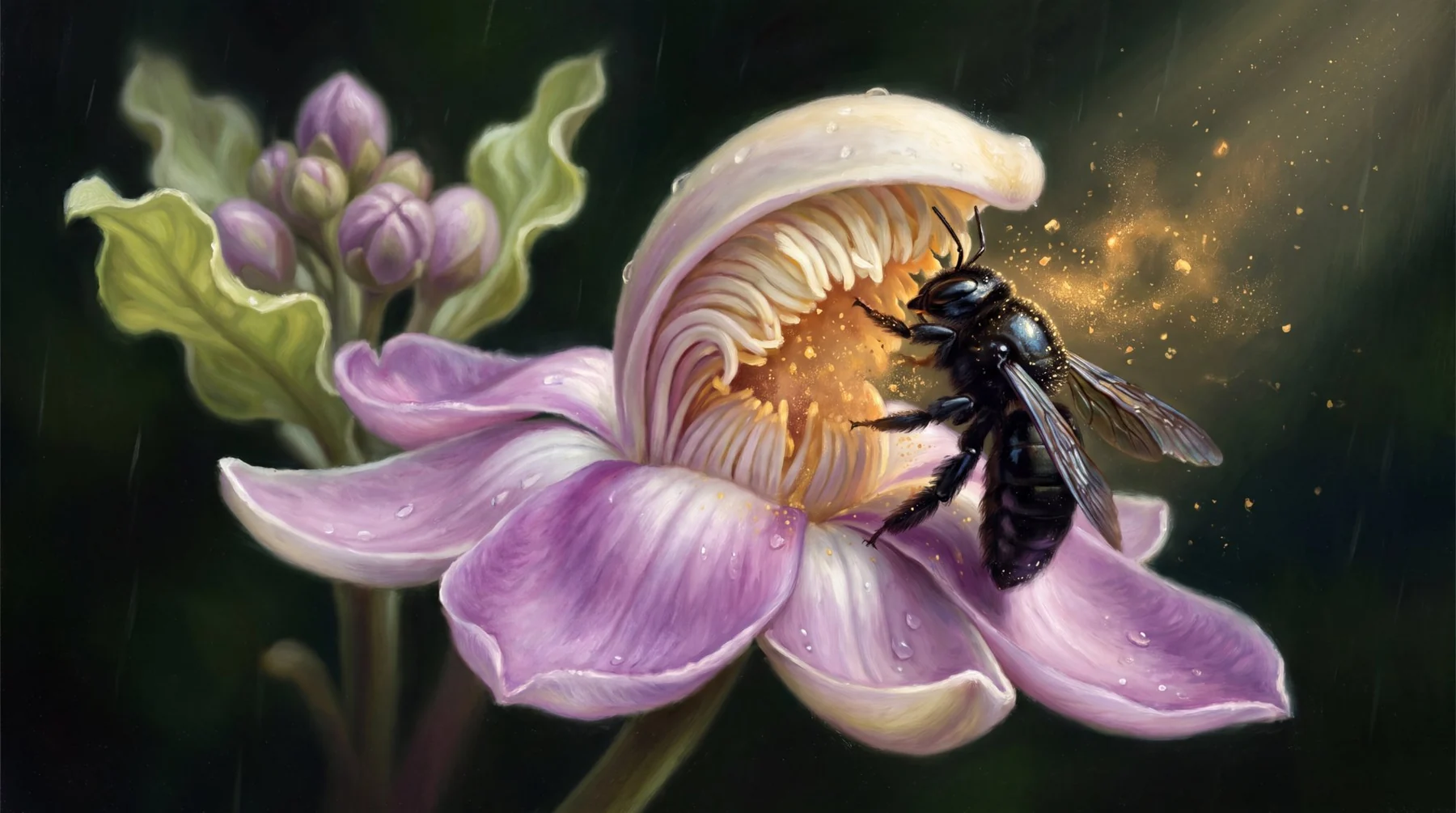
Its lilac flowers hide the stamens under a curved lid that only large bees can push open. Inside, a pollen waits that exists to be eaten.
New leaves, new flowers
The monkey pot is deciduous. Before flowering it drops almost all its foliage and, as it renews it, opens its flowers: new light-green leaves and upright clusters of buds that bloom from the bottom up. In Costa Rica this happens in the middle of the year, between May and August depending on the area.
Each flower is about 3 cm across. It has six rounded petals, pink or pale lilac on the outside and white on the inside, which fade to white as the flower ages.
A hood of stamens
The strangest part is in the centre. Its 130 to 170 stamens do not form a simple tuft: the androecium extends into a curved tongue, 13 to 18 mm long, that folds over the centre of the flower like a hood. That structure is the hallmark of many Lecythidaceae.
The hood is not the same all the way along. In the ring around the pistil there are stamens with fertile pollen. In the hood there are staminodes, with normal-looking anthers that produce only fodder pollen: pollen that fertilises nothing and is made to feed the visitor.
Two pollens and a strong bee
To reach the pollen in the hood, a bee has to push it open and crawl underneath. As it forces its way in, it brushes against the fertile stamens and the stigma. It takes food home for its young and, without meaning to, carries the pollen that will fertilise the next flower.
Not just any insect can do it. The recorded visitors of the monkey pot are large bees: carpenter bees of the genus Xylocopa, bumblebees of the genus Bombus and medium to large euglossine bees.
Ten months later
Each pollinated flower starts a fruit that will take about ten months to become a woody pot. Meanwhile, the open pots of the previous cycle may still hang in the crown.
The photograph of the flowers of the Sarapiquí individual shows that beginning: clusters with many closed buds, freshly opened lilac flowers and new wavy-edged leaves. It is the first scene of the story that ends in the monkey's pot.
Sources and further reading
Original synthesis based on the following publications.