
The pods that were waiting for an extinct giant
The curled fruit of Costa Rica's national tree seems made for animals that vanished thousands of years ago. Today, horses and cattle fill only part of that gap.
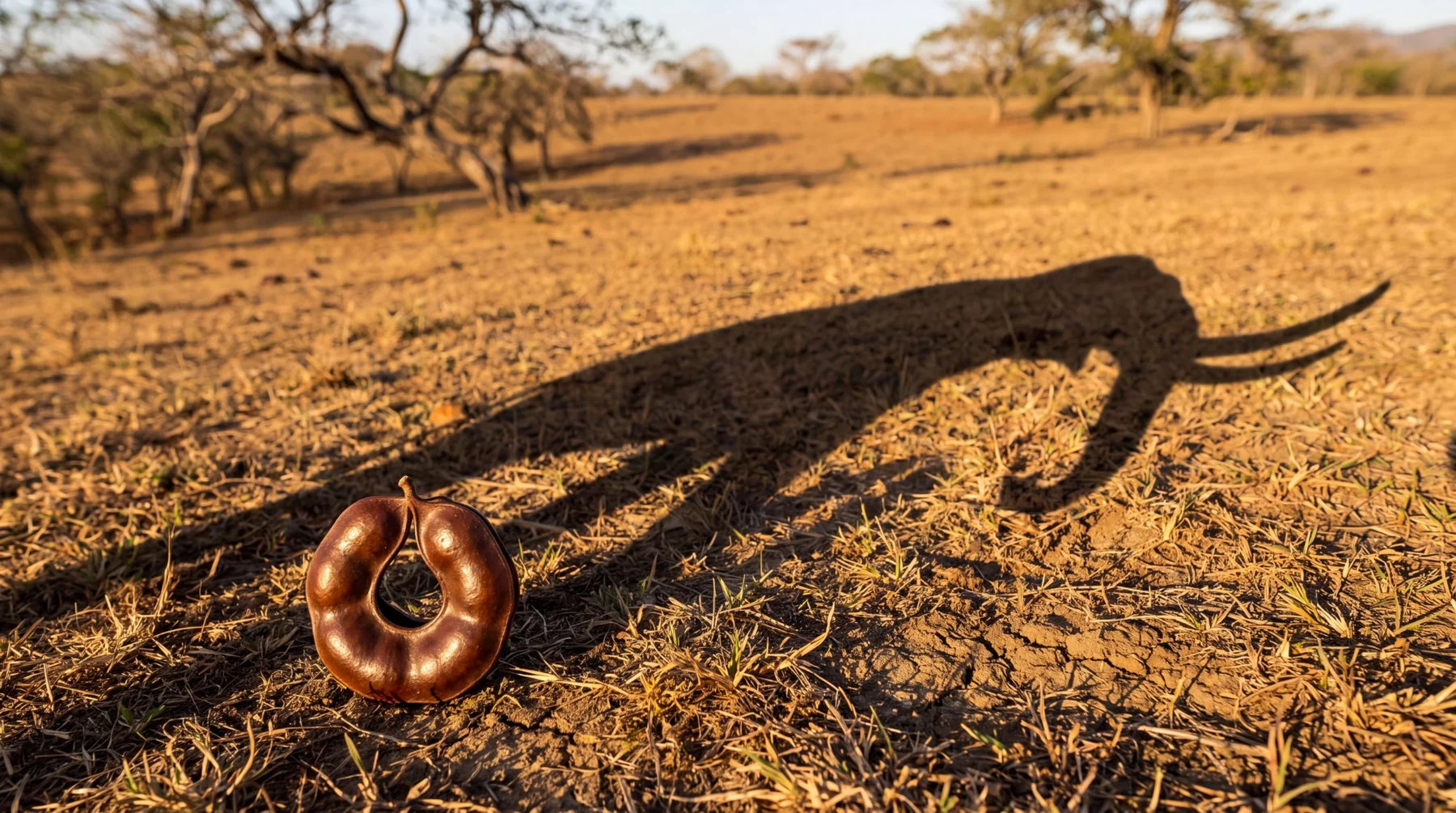
A fruit without a diner
The guanacaste pod does not open by itself or break easily. It is hard and heavy, wrapping sweet pulp around seeds that are hard as well. That design fits poorly with the animals that share the tree's range today: few living mammals in American forests have the size or the habit to swallow whole fruits several centimetres across.
In 1982, biologists Daniel Janzen and Paul Martin proposed an explanation in the journal Science: fruits like this evolved to be eaten by Pleistocene megafauna — gomphotheres, giant ground sloths and other large mammals that disappeared from the Americas between 10,000 and 13,000 years ago. The guanacaste would be an evolutionary anachronism: a species that keeps traits adapted to dispersers that are gone.
Horses where gomphotheres once were
If the original animals vanished, who moves the seeds today? Janzen studied what happens to them when a horse eats them. The horse was not a random choice: native horses lived in Costa Rica during the Pleistocene and went extinct with the rest of the megafauna. The Spanish brought horses back a little over 500 years ago.
In six horses, the seeds took between 2 and 60 days to pass, with an average of 13 to 16 days, and between 8% and 56% survived the trip through the gut, depending on the animal. One detail completes the picture: surviving seeds germinated no better than seeds taken by hand from a pod. The horse helps carry the seed away from the parent tree, but gives it no advantage for germination.
From pasture to shade
Today cattle also eat the fallen pods, and the guanacaste is part of Central America's pastures: its wide crown shades the animals and its pods are used as fodder in the dry season, when grass is scarce. That usefulness partly explains why it remains common as a lone tree even where the original forest has disappeared.
The tree in the Jiménez square shows another relationship: it stands not in a pasture but in a public space. It is a shade tree chosen by a community, beyond its role in ranching.
A hypothesis still under debate
The idea of evolutionary anachronisms is influential, but it is not settled. A 2019 study followed six large-fruited palm species in Bolivia and Brazil and recorded 54 vertebrate species moving their seeds, above all parrots carrying them in their beaks over long distances. Livestock, by contrast, barely dispersed them. The work does not refute what Janzen and Martin described for the guanacaste, but it is a reminder that each species needs its own evidence before assuming that livestock replace the extinct megafauna.
Meanwhile, the damp bark of the Jiménez guanacaste supports a garden of epiphytes that depends on no horse and no gomphothere. A single tree carries, at once, an evolutionary story thousands of years old and a living community renewed with every rainy season.
Sources and further reading
Original synthesis based on the following publications.
- Janzen y Martin (1982) · Neotropical Anachronisms: The Fruits the Gomphotheres Ate
- Janzen (1981) · Enterolobium cyclocarpum seed passage rate and survival in horses, Costa Rican Pleistocene seed dispersal agents
- Winrock International · Enterolobium cyclocarpum: the ear pod tree for pasture, fodder, and wood
- Blanco, Tella, Díaz-Luque y Hiraldo (2019) · Multiple external seed dispersers challenge the megafaunal syndrome anachronism and the surrogate ecological function of livestock
- Museo Nacional de Costa Rica · Cactus epífitos del país