
When a tree falls, the forest continues
Fallen wood is not the end of a tree: it is the beginning of other ways to inhabit a forest.
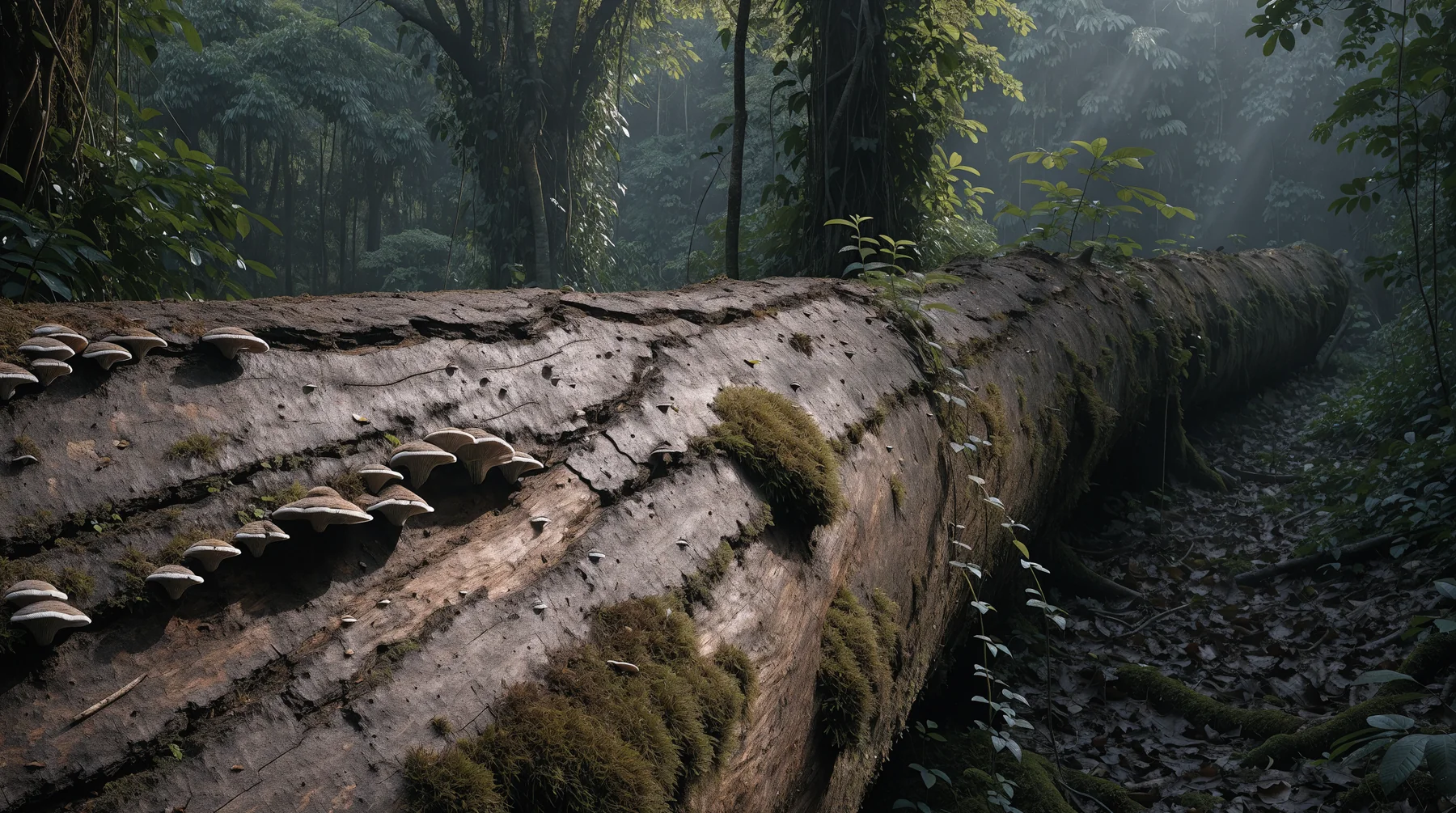
After the crash
A falling tree sounds like an interruption. Its crown passes through others, light reaches a place that was shaded, and a trunk lies across the ground. If we see a forest only as a collection of standing trees, the scene looks like a complete loss. Yet the fallen tree does not disappear when it can no longer hold its crown. It changes position and begins to offer surfaces, shelter and food to organisms that could not occupy it in the same way before.
Wood retains for years some of the carbon the tree fixed while it lived. Decomposition does not happen all at once: it depends on climate, the size and composition of the trunk, and the organisms that colonise it. Fungi, bacteria and invertebrates help transform tough tissue into material that returns to the soil. Speed matters, but so does succession: a freshly fallen trunk and a soft one covered in moss do not support precisely the same community.
Life in the galleries
Insect galleries may appear beneath the bark. Fungal threads grow in damp cracks; mosses and seedlings establish themselves on the wood. Some species eat the wood directly, others use the fungi that break it down, and still others arrive to find prey or shelter. Deadwood ceases to look like an inert object when we observe it at this scale. It is a small landscape whose inhabitants change with moisture and the condition of the tissue.
That variety explains why removing every fallen trunk changes more than the appearance of a forest. Stages of decay, sizes of wood and small habitats are lost, and no living tree replaces them on its own. A forest can have green crowns and still lack some of the processes that sustain its life. The wish to “clean” a forest therefore deserves an earlier question: for whom was the thing we are removing useful?
Restoration includes processes
When restoring a site, we tend to count the trees planted and measure their growth. These indicators matter, but they describe only the most visible part. A functioning forest also needs leaf litter, living soil, wood at different stages and organisms capable of transforming it. Fallen trunks can help sustain some of those relationships, although the outcome depends on the place and cannot be reduced to a universal rule.
Retaining wood in suitable places may preserve moisture, offer shelter and provide a substrate for fungi and other decomposers. There are also practical circumstances where it must be removed for safety or management. The thoughtful choice is not to idealise every log, but to recognise that deadwood performs ecological work. Restoration that systematically removes this phase risks creating a forest that looks orderly yet is biologically simpler.
Conserving the whole timeline
In the gallery we contemplate complete trees, upright and separated from the background. Showing them this way lets us read their architecture with a clarity rarely available in the forest. But the photographic cut-out also has a temporal edge: it gives us one moment in a life that began earlier and will continue, differently, after the fall. The living tree and the decomposing trunk are not competing stories. They are phases in the same circulation of matter and possibility.
Protecting a forest means allowing it to retain ages, hollows, falls and fresh starts. Next time you encounter a moss-covered log, move closer without disturbing it and look at how much is happening on its surface. “Dead” may accurately describe the tree as an individual; it describes the place it has become much less well. There, in the wood that slowly gives way, the forest continues.
Sources and further reading
Original synthesis based on the following publications.