
The ceiba after sunset: a forest connected by bats
Night-opening flowers, pollen crossing the landscape and wind-borne seeds: ceiba reproduction in Costa Rica.
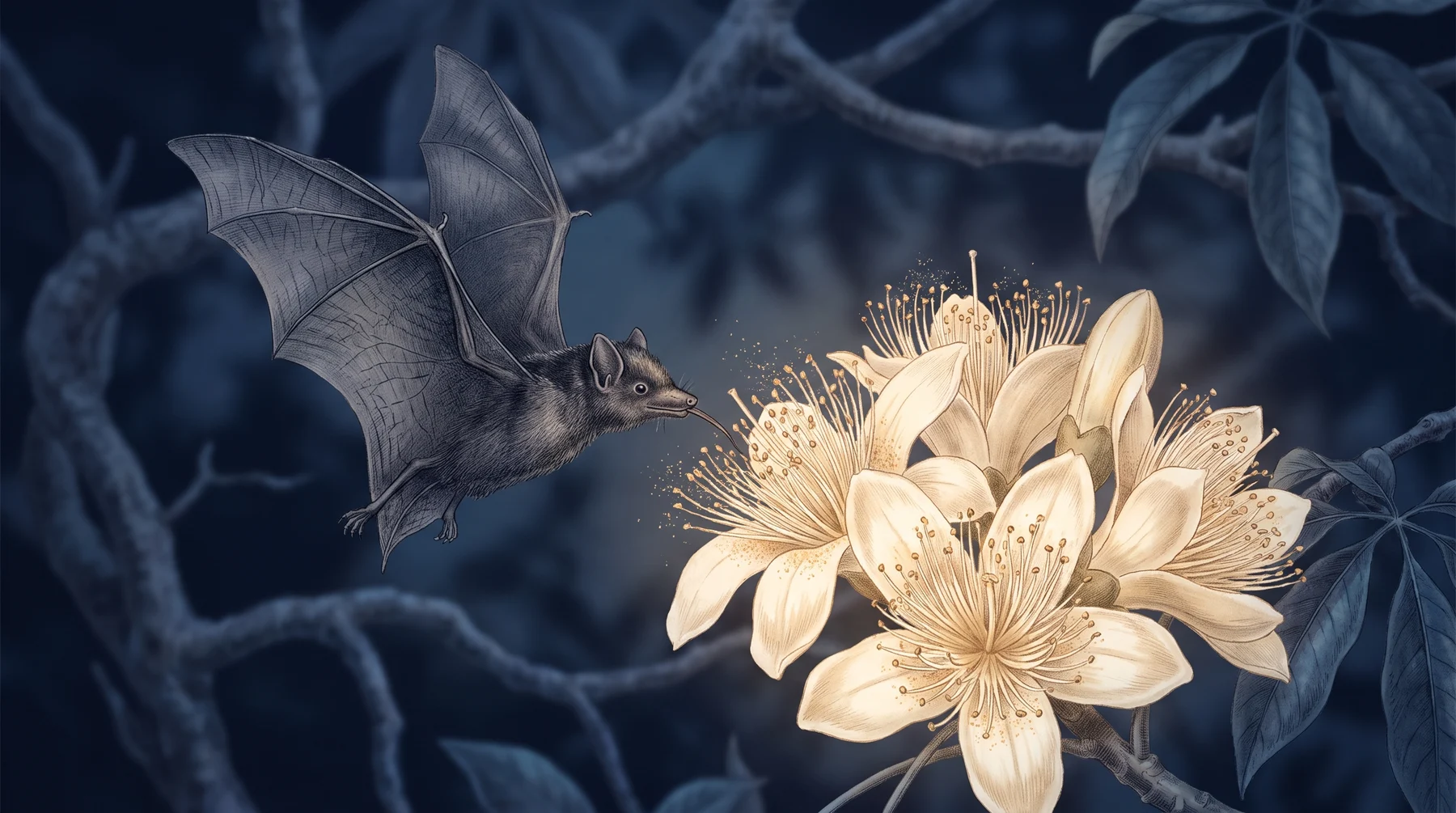
Flowers for the night
A ceiba can dominate a landscape while concealing the process that connects its population. Buttresses and a spreading crown command attention by day. Pollen exchange, however, can happen at night, carried by animals travelling between separate trees.
Ceiba pentandra flowers open at night and offer nectar. A feeding bat may contact the structures that produce pollen. Some pollen sticks to its body and can reach another flower on a later visit. Pollination by bats is known as chiropterophily.
Guanacaste and Osa: two reproductive pathways
In Guanacaste, researchers identified Glossophaga soricina and Phyllostomus discolor as important ceiba visitors: captured bats carried pollen from its flowers. That transport enables cross-fertilisation, in which pollen from one tree contributes to seeds produced by another.
A Costa Rican study published in 2005 compared populations in Guanacaste and Osa. During nocturnal observations it recorded 137 bat visits in Guanacaste and none in Osa within the sampling period. Genetic analyses found more self-fertilisation in Osa. The ceiba thus showed reproductive flexibility, producing offspring through crosses between individuals or using its own pollen.
The authors proposed that nectar in the dry forest could be especially attractive as a food and water resource during the dry season. The relationship between tree and pollinator also depends on what the surrounding landscape offers at that time.
Connections invisible from the ground
Another study, conducted in southern Costa Rica and published in 2013, examined grouped and isolated trees. Genetic markers allowed researchers to reconstruct reproductive patterns across two flowering seasons.
Among grouped ceibas, much of the pollen came from neighbours less than a kilometre away. Crosses involving isolated trees included pollen arriving from greater distances. Spatial isolation did not significantly reduce outcrossing in that population: pollinator movements maintained connections that were not apparent from the distribution of trunks.
Results also changed between years. When fewer individuals flowered, crosses between neighbours declined and self-fertilisation increased among grouped trees. Reproductive connectivity depended both on distance and on overlapping flowering periods.
The second journey: seeds
After fertilisation, a second journey begins. Ceiba fruits form capsules containing seeds accompanied by fibres known as kapok. When a fruit opens, this light material aids wind dispersal. The buoyant, poorly absorbent fibres have also been used as stuffing and flotation material.
Ceiba reproduction connects two kinds of movement: animals carrying pollen and air dispersing seeds. The tree stays in place, but its offspring depend on exchanges extending beyond its crown. In the Costa Rican landscape, protecting a ceiba also protects a meeting point between flowering, nocturnal flights and future generations of trees.
Sources and further reading
Original synthesis based on the following publications.